
Roughly 40% of every digital advertising dollar goes to waste. Not “underperforming.” Wasted. Served to bots, expired cookies, audiences built on probabilistic guesses that never connected an ad to an actual human being at an actual address.
Most marketers know this. They’ve seen the campaign reports where impressions look strong but conversions tell a different story. The targeting said “in-market homeowners age 35 54” and delivered ads to a teenager’s tablet in a college dorm.
The problem isn’t execution. The problem is the foundation. And the foundation of most digital advertising is still the cookie.
Cookies Were Built for a Web That No Longer Exists
Cookies track browsers. Not people. Not households. Browsers.
When a user clears their cache, switches devices, or opens an incognito window, the cookie trail goes cold. Major browsers have restricted or eliminated third-party cookies altogether. Privacy regulations like CCPA have tightened the rules around data collection. And consumers are running ad blockers at record rates.
The industry response has been to layer workaround on top of workaround. Fingerprinting. Universal IDs. Probabilistic matching that uses statistical models to guess which devices belong to which person. These approaches get close sometimes. But “close” and “verified” are not the same thing.
When your targeting is probabilistic, your results are probabilistic too. You’re spending real dollars on estimated audiences.
Starting From Something Real
El Toro took a different approach back in 2012, and it started with a simple question: what if targeting began with a verified physical address instead of a browser cookie?
That question led to the Digital Trinity. Three linked identifiers that connect the physical world to the digital world:
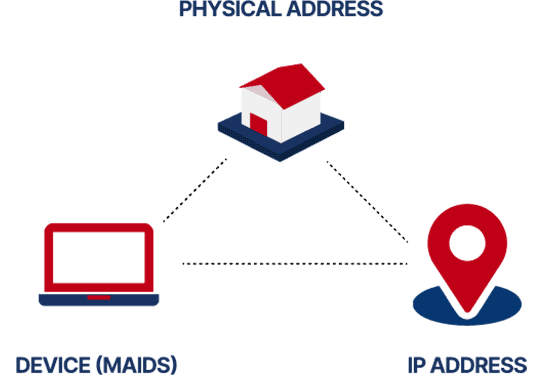
Physical Address: The starting point. A verified mailing address from a CRM list, voter file, direct mail database, or any other address source the client already has.
This is deterministic data. Real people at real locations.
IP Address: El Toro’s patented algorithm matches each physical address to the household or building’s IP address with 95%+ confidence. No cookies involved. No probabilistic modeling. A direct, verified connection between where someone lives and how they access the internet.
Device ID: Mobile Advertising IDs captured through El Toro’s proprietary GeoFraming™ technology at physical locations. A device observed at a car dealership, a campus visit day, or a competitor’s store gets traced back to its home IP address. The reach extends from a single location visit to every device in the household.
These three layers are what make El Toro’s targeting deterministic. Each connection is verified through patented processes. 18+ patents protect this methodology, and no competitor can replicate the exact approach without licensing.
The Digital Trinity is the foundation under every El Toro product. IP Targeting, Venue Replay®, Digital New Movers®, OTT/Connected TV, Digital Canvassing. Each one uses some combination of address, IP, and device ID to reach verified households instead of anonymous browser profiles.
And because none of it depends on cookies, the system is immune to browser changes, privacy regulations, and ad-blocking technology that are making cookie-based approaches less reliable every quarter.
What Deterministic Targeting Actually Produces
The gap between probabilistic and deterministic shows up in the numbers.
A university deployed IP Targeting to reach prospective students and hit a 5x higher conversion rate with a 75% address-to-IP match rate. Three out of four addresses on their list were successfully matched and served ads.
A fitness brand ran IP Targeting for less than a month. Twenty-seven days. The result was 22 new signups and a 54% lift in sales.
A food delivery service used Digital Canvassing to target neighbors of existing customers. Orders from those households jumped 55% compared to untargeted areas. Same product, same pricing, same creative. The only variable was who saw the ad.
These numbers come from the same principle every time. Start with a verified address. Match it to an IP. Deliver ads to the right household. The targeting is only as complicated as the outcome is clear.
These numbers come from the same principle every time. Start with a verified address. Match it to an IP. Deliver ads to the right household. The targeting is only as complicated as the outcome is clear.

Three Steps to Deploy
Most advertisers expect a complex onboarding process. The reality is straightforward.
1. Provide your address list
Upload CRM data, a voter file, or a customer list. Standard address formats work. The same lists you’d send to a direct mail house.
2. El Toro matches addresses to IPs
The patented algorithm connects each physical address to its household IP. No cookies, no behavioral models, no third-party data brokers in the middle.
3. Your ads reach verified households
Display banners, video, OTT/CTV streaming, native formats. Your creative runs across desktops, laptops, tablets, smartphones, and smart TVs connected to the matched IP addresses.
For campaigns using Venue Replay®, there’s an additional layer. When someone visits a physical location (a competitor’s dealership, a college campus, an event venue), their device ID is captured through GeoFraming™ and traced back to a home IP. One visit extends to the whole household.
When the campaign wraps, El Toro’s MatchBack Analysis closes the loop with one-to-one conversion attribution. Not modeled estimates. Verified matches between ad exposure and actual conversions, delivered as a report within five business days.
The Post-Cookie Playbook
The advertisers positioned to win over the next five years aren’t scrambling for cookie alternatives. They moved to a deterministic, address-based model that never needed cookies in the first place.
El Toro has operated this way since day one. The Digital Trinity connects physical addresses to IP addresses to device IDs, and 18+ patents make sure that connection stays proprietary.
If your current targeting still depends on cookies, the question isn’t whether to switch. It’s how much you’re comfortable wasting before you do.